


Published by SESI Care Services · August 2026
Quick answer: Home care services bring support to you, in your own home, instead of asking you to move into a facility. They can cover personal care, help around the house, nursing, therapy and company. In Australia, home care support is usually funded through the NDIS (for people with disability) or Support at Home and the Commonwealth Home Support Programme (for older people). You can also pay privately. Most people start by working out what help they actually need, then talking to a provider.
Key takeaways
- Home care services deliver support where you already live — no need to move.
- They cover a wide range: personal care, household tasks, nursing, therapy, transport and social support.
- Disability care in Australia is mainly funded by the NDIS; aged care at home is funded through Support at Home or the CHSP.
- Support is built around the individual, and can change as needs change.
- Family carers get a break too — respite is a recognised, fundable support.
- Choosing a provider comes down to fit: the services they offer, their staff, and how flexible they are.
What are home care services?
Home care services are supports delivered in your own home rather than in a hospital, group home or aged care facility. The idea is simple: keep the person in the place they know, and bring the help to them.
Care in the home services usually fall into three broad groups:
- Personal care — bathing, showering, dressing, grooming, toileting and help with medication.
- Household help — cleaning, laundry, meal preparation and general upkeep so the home stays safe and comfortable.
- Clinical and allied health — community nursing, wound care, physiotherapy and occupational therapy.
Alongside those sit the supportive services that often matter just as much day to day: company and conversation, help getting to appointments, and support to join in with community activities.

An in-home care service is not fixed. A good one starts with a conversation about what you want your week to look like, then builds the support around that — and adjusts it when things change.
Types of home care services available
| Type of support | What it looks like |
|---|---|
| Personal care | Showering, dressing, grooming, continence support, medication prompts |
| Household tasks | Cleaning, laundry, meals, shopping, keeping the home safe |
| Community nursing | Wound care, medication management, clinical monitoring |
| Allied health | Physiotherapy, occupational therapy, mobility and equipment advice |
| Transport and access | Getting to appointments, work, study or social activities |
| Social and community support | Company at home, group activities, staying connected |
| Respite | Short-term cover so a family carer can rest |
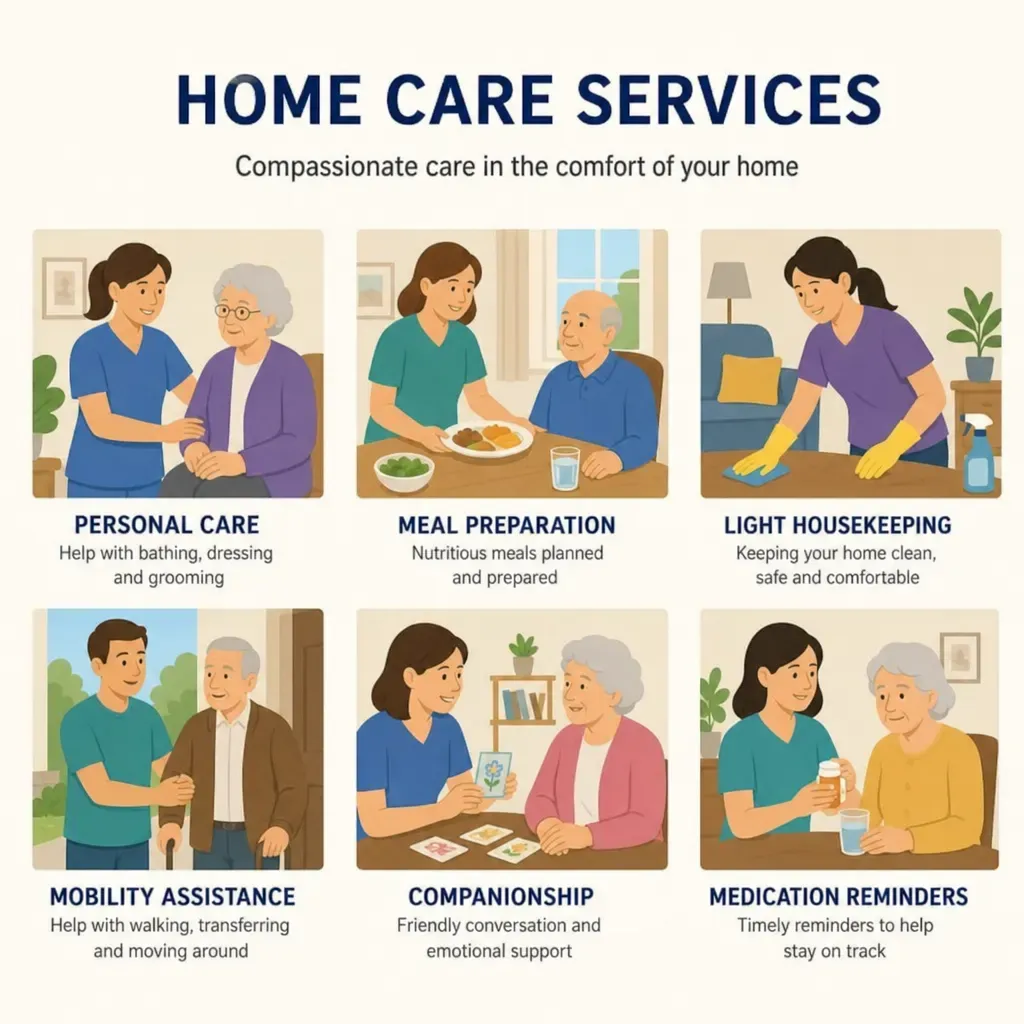
Most people don’t use just one of these. A typical arrangement mixes two or three — for example, personal care each morning, household help once a week, and transport to a regular appointment.
You can read more about the specific supports SESI delivers on our services page.
Who can benefit from home care?
Home care suits more people than most expect. The main groups are:
- People with disability who need regular support with daily activities, mobility or personal care.
- Older people who want to stay in their own home rather than move into residential aged care.
- People recovering from surgery, illness or injury who need help for a period of time.
- People living with chronic conditions where steady, predictable support prevents things getting worse.
- Family carers who need respite so they can keep going.

If you’re unsure whether your situation fits, it’s worth asking. Eligibility for funding is a separate question from whether home care would help — and providers can usually tell you quickly which funding path applies to you.
Home care for people with disability
For disabled people, home care support is about far more than tasks getting done. Good disability care builds capability: doing things with someone rather than for them, so skills and confidence grow over time.
That might mean a support worker who helps with cooking in a way that gradually hands the cooking over. It might mean support to catch public transport independently. It might mean steady personal care that removes a daily source of stress so energy goes somewhere better.
Disabled support at home also tends to be more consistent than facility-based care, because it’s usually the same small team each week. That continuity matters — people shouldn’t have to explain their own needs from scratch every visit.
Common supports for people with disability include:
- Assistance with daily personal activities
- Help with household tasks
- Assistance with travel and transport
- Support to participate in community activities
- Development of daily living and life skills
- Community nursing and allied health
Funding and access in Australia
This is where a lot of general advice about home care goes wrong, because the Australian system is specific. There are three main pathways.
1. The NDIS — for people with disability
The National Disability Insurance Scheme funds supports for eligible people with permanent and significant disability, generally under 65 at the time of application. If you have an NDIS plan, home care supports are typically funded from your Core Supports budget, with capacity-building supports funded separately.
2. Support at Home — for older Australians
Support at Home replaced the Home Care Packages Program and the Short-Term Restorative Care Programme on 1 November 2025. It funds ongoing services at home for older people assessed as needing them, across service groups including clinical care, independence support and everyday living.
3. The Commonwealth Home Support Programme (CHSP)
CHSP provides entry-level support for older people who need a smaller amount of help — things like a bit of domestic assistance or transport. CHSP has been extended to 30 June 2029 and transitions into Support at Home after that.
Alongside these, you can pay privately for home care at any time, with no assessment and no waiting list. Some people use private services to top up funded supports, or to get started while an assessment is in progress.
One correction worth making: private health insurance does not fund ongoing home care in Australia, despite what a lot of general online advice suggests. Don’t plan around it.
How to get in-home support services
The path is more straightforward than it looks:
- Work out what you actually need. Write down the parts of the week that are hardest. Be specific — “mornings are difficult” is more useful than “I need help”.
- Find your funding pathway. For disability, apply to the NDIS. For aged care, contact My Aged Care for an assessment. If neither applies yet, private is an option.
- Research providers. Look at what they deliver, whether they’re registered, and what people say about them.
- Talk to two or three. Ask about their workers, how they match staff to people, what happens if a shift is missed, and how quickly support can change if your needs do.
- Start, then review. The first arrangement is rarely the final one. Good providers expect to adjust it.
If you’re supporting someone else through this — a family member, or a participant you coordinate for — our referral form is the fastest way to start a conversation.
Choosing the right home care provider

Three things separate providers that work from providers that frustrate:
Service range. Can they cover everything you need, or will you end up juggling several providers? Mixed arrangements can work, but they’re more admin.
The people. Home care is delivered by an individual walking into your home. Ask how workers are matched to clients, what training they receive, and how much continuity you can expect.
Flexibility and reliability. Needs change, and shifts occasionally fall through. Ask directly what happens when a worker calls in sick, and how much notice is needed to change a roster.
Reviews and referrals help, but so does a direct conversation. You will learn more from ten minutes on the phone than from an hour on a website.
Frequently asked questions
What types of home care services are available?
Personal care, household help, community nursing, allied health, transport, social support and respite. Most people use a combination.
How much do home care services cost?
It depends on the support type, the time of day, and whether it’s funded or private. NDIS supports are priced under the NDIS Pricing Arrangements. Under Support at Home, contributions vary by service type and individual circumstances.
Can I change providers?
Yes. You are not locked in. If an arrangement isn’t working, you can move.
Can I get support if I’m not eligible for the NDIS or aged care funding?
Yes — privately funded home care is available without an assessment.
In short
Home care services let people stay where they are most comfortable while getting the support they need. For people with disability and for older Australians alike, that combination — familiar surroundings, consistent people, support shaped around the individual — is what makes the difference to day-to-day life.
If you’d like to talk through what support might look like, call 1800 017 374 or tell us what’s going on. We’re happy to help you work out the right path, even if it turns out we’re not the right provider for you.
Ready to talk?
See how SESI can support you or someone you love.